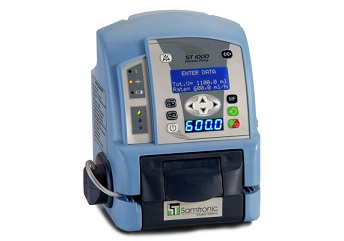
Aninfusion pumpinfusesfluids,药物治疗ornutrientsinto apatient’scirculatory system. It is generally usedintravenously, althoughsubcutaneous,arterialandepiduralinfusions are occasionally used.
Infusion pump can administer fluids in ways that would be impractically expensive or unreliable if performed manually by nursing staff. For example, they can administer as little as 0.1 mL per hour injections (too small for a drip), injections every minute, injections with repeatedbolusesrequested by the patient, up to maximum number per hour (e.g. inpatient-controlled analgesia), or fluids whose volumes vary by the time of day.
Because they can also produce quite high but controlledpressures, they can inject controlled amounts of fluids subcutaneously (beneath the skin), or epidurally (just within the surface of thecentral nervous system– a very popular local spinalanesthesiaforchildbirth).
Theuser interfaceof pumps usually requests details on the type of infusion from the technician or nurse that sets them up:
- Continuous infusionusually consists of small pulses of infusion, usually between 500 nanoliters and 10 milliliters, depending on the pump’s design, with the rate of these pulses depending on the programmed infusion speed.
- Intermittent infusionhas a “high” infusion rate, alternating with a low programmable infusion rate to keep thecannulaopen. The timings are programmable. This mode is often used to administerantibiotics, or other drugs that can irritate a blood vessel.
To get the entire dose of antibiotics into the patient, the “volume to be infused” or VTBI must be programmed for at least 30 CCs more than is in the medication bag…or else up to half of the antibiotic will be left in the IV tubing.
- Patient-controlledis infusion on-demand, usually with a preprogrammed ceiling to avoid intoxication. The rate is controlled by a pressure pad or button that can be activated by the patient. It is the method of choice forpatient-controlled analgesia(PCA), in which repeated small doses ofopioidanalgesicsare delivered, with the device coded to stop administration before a dose that may cause hazardous respiratory depression is reached.
- Total parenteral nutritionusually requires an infusion curve similar to normal mealtimes.
Some pumps offer modes in which the amounts can be scaled or controlled based on the time of day. This allows forcircadian cycleswhich may be required for certain types of medication
[mpc_vc_products_slider type="custom" columns="4" ids="4111, 3623, 4073, 4108, 3618, 3621, 3619, 3653, 3730, 4109"]

Reviews
There are no reviews yet.