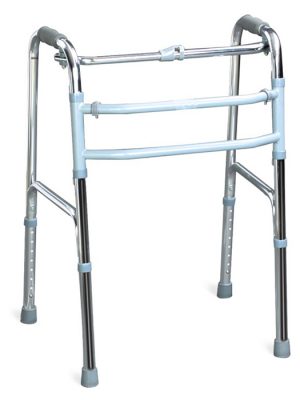
A Folding Walker or步行frameis a工具fordisabledor elderly people who need additional support to maintain balance or stability while步行. In the英国, 一个common equivalent term for a walker isZimmer frame, 一个通用商标从Zimmer Holtings, 一个major manufacturer of such devices and关节更换部分。
折叠式沃克(Walker)于1950年代初开始出现。美国第一项专利于1953年授予英国斯特雷特福德的威廉·克里布斯·罗布(William Cribbes Robb),用于“步行援助”的设备,该设备于1949年8月向英国专利局提交。[1]Two variants with wheels were both awarded US patents in May 1957,[2][3]1965年,俄亥俄州辛辛那提的Elmer F. Ries在1965年获得了第一个被称为“ Walker”的非轮毂设计。[4]1970年,加利福尼亚州范努伊斯的阿尔弗雷德·A·史密斯(Alfred A.
The basic design consists of a lightweight frame that is about waist high, approximately 12 inches (30 cm) deep and slightly wider than the user. Walkers are also available in other sizes such aspediatric(适用于儿童)或bariatric(for obese persons). Modern walkers are height adjustable and should be set at a height that is comfortable for the user, but will allow the user to maintain a slight bend in their arms. This bend is needed to allow for proper blood circulation through the arms as the walker is used.
折叠步行者的前两条腿可能会或可能没有轮子,具体取决于使用它的人的强度和能力。也很常见casterwheels or glides on the back legs of a walker with wheels on the front; additionallyfelt适合与腿部(例如粘合脚)滑行的产品tennis balls将孔切入其中,将它们放在腿上的情况下,也将其用于机构常见的硬木,环氧树脂和油毡地板等表面。
该人的正面和侧面周围的框架行走,双手通过握住框架侧面的顶部来提供更多的支撑。传统上,一个助行器被捡起,并在用户领先一小段距离之前。然后,用户走到其中并重复该过程。通过使用轮子和滑行,用户可以将步行者推向前进,而不是捡起它。这可以更轻松地使用步行者,因为它不需要用户使用手臂来抬起步行者。这对那些手臂力量少的人是有益的。
那些因腿部或背部受伤而恢复的人通常会使用步行者。它也是经过步行或轻度平衡问题的人通常使用的。
Also related is a hemi-walker, a walker about half the size of a traditional Folding Walker which is intended for use by persons whose dexterity is limited or non-existent in one hand or arm. These walkers are more stable than a quad cane (a cane with four points that touch the ground, as opposed to one), but are not recommended as highly as a traditional walker for those who can use it.




Reviews
尚无评论。