

Accu-Chek Active blood glucose meter
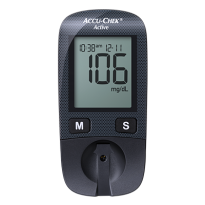
Item DescriptionThe Accu-Chek Active blood glucose meter packs many powerful features into a smaller size than the previous version. See test result averages up to 90 days, get alerts if your test strips are expired or if you’ve underdosed, re-dose within 10 seconds, set pre-and post-meal reminders to test, and more.
Product Manuals
SIZE
97.8 x 46.8 x 19.1mm
WEIGHT
50 g
FAST
Results in 5 seconds
MEMORY
500 test results
ALERTS
For expired strips
Benefits and features
- Just two buttons are used to operate the meter, for intuitive handling.
- Large and easy-to-read display.
- In- or out-of-meter for simple and comfortable testing.
- Safety features include underdosing alerts, re-dose option in 10 seconds, and test strip expiration warnings
- The visual double check lets you see your recent test result.
- Post-meal alert reminds you to test 2 hours after eating.
- Pre-meal and post-meal markers are available.
- 500 test results are stored in memory.
- See averages of all blood test results over 7, 14, 30 and 90 days.
- Fulfills 100 % of the accuracy requirements of DIN EN ISO 15197:2003.1
- Date and time are preset for faster setup.
- Changing the battery doesn’t mean losing the date and time settings.
- Transfer data from the meter to your PC using a USB cable. You will need an
Accu-Chek diabetes management solution on the PC to analyze the data. - 30 % smaller than previous Accu-Chek Active meters with a 10 % bigger display.
Additional specifications
Accu-Chek Active (Model GU)
Unique serial number is printed on a label on the device and stored in non-volatile memory
Mutant variant of the glucose dehydrogenase quinone protein (Mut. Q-GDH 2, modified variant of EC 1.1.5.2), acinetobacter spec; photometric end-point measurement
Approximately 5 seconds (blood application with test strip within the meter)
Approximately 8 seconds (blood application with test strip outside the meter)
+8 to +42 °C (+46.4 °F to +107.6 °F)
Up to 93 % relative humidity
-25 to + 70 °C (-13 °F to +158 °F)
Up to 500 values with date and time
7, 14, 30, 90 days
Via USB interface (with Micro-USB cable)
Via code chip (batch specific code chip)
Strip expiry warning (data is stored in the code chip)
97.8 x 46.8 x 19.1 mm
46 g without battery, 50 g with battery
96 segments LCD display with symbols
Yes (Factory setting ON)
1 battery, type CR 2032
Approximately 1000 measurements or one year (whichever comes first)
30 or 90 seconds according to operating status
Yes
0–4,000m (0-13,123 feet)
1-2 μL
10 mg/dL – 600 mg/dL, 0.6 mmol/L – 33.3 mmol/L
Capillary blood
静脉血实际上与肝素锂or ammonium heparin or EDTA, arterial blood and blood from neonates
Blood application on to the middle of the test pad. The test strip (and its components) has the function to spread the blood above the test area in a quick and hygienic way
Blood can be applied to already inserted test strip, or a test strip outside the meter. Outside of the meter dosing is helpful to minimize the risk of contamination when a meter has multiple users (e.g. in a hospital) and, in case of alternative site testing, to facilitate blood application
Additional blood can be added to the test strip within 10 seconds after applying the first drop (applies for inside mode)
Plausibility check option with 5 color block on the test strip vial
20 – 55 % (within-meter mode), 20 – 70 % (outside-meter mode)
生产日期后18个月。测试条remain stable at least up to the expiry date printed on the test strip vial, even after opening (the test strip container must be closed tightly after each test strip is removed)
Testing your blood glucose is an essential part of managing diabetes. The Accu-Chek Active blood glucose meter can help to make it convenient by giving you fast, hassle-free, and accurate results in 4 simple steps.
- Insert the glucose test strip
- Prick your finger with the lancet to draw out a blood drop.
- Carefully touch the blood drop onto the green field of the test strip.
- Read the blood glucose result.


Reviews
There are no reviews yet.